
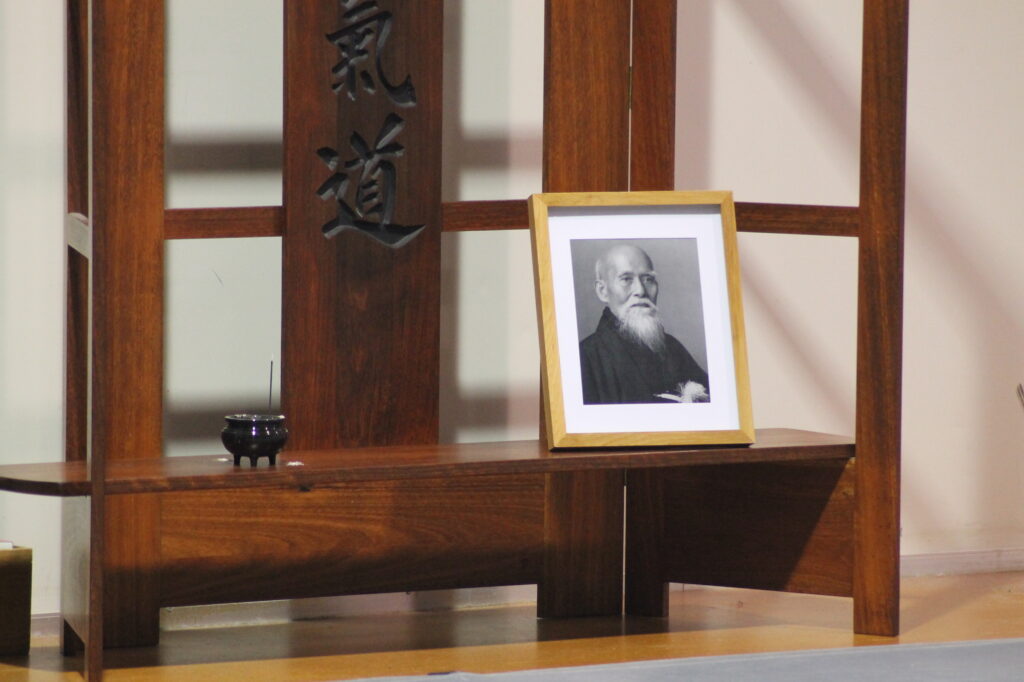
The Way of Harmony
Aikido is a traditional Japanese martial art founded by Morihei Ueshiba (1883–1969), often referred to as O-Sensei (Great Teacher). His art evolved from years of deep training in martial disciplines such as Kito-ryu Jujutsu, Yagyu-ryu Jujutsu, and Daito-ryu Aiki-jutsu.
What Does Aikido Mean?
The word Aikido is made up of three Japanese characters:
-
AI (合) – to meet, come together, harmonise
-
KI (気) – energy, spirit, or life force; also the universal spirit in Japanese philosophy
-
DO (道) – the way or path
Together, Aikido means “The Way of Harmonising with the Universal Spirit.” It is a martial art rooted in balance, connection, and inner calm.
Aikido as Self-Defence
Aikido is one of the most effective forms of self-defence taught today, not because of brute strength or rigid techniques, but because of its adaptability. It has no set rules or competition, allowing practice against any kind of attack, with or without weapons.
What makes Aikido unique is its purely defensive nature. Techniques involve pins (immobilisations) and throws (projections) that neutralise aggression without causing lasting harm. When applied precisely, they can be extremely powerful—even lethal—yet the emphasis remains on control, compassion, and restraint.
Philosophy in Practice
Aikido teaches you to protect yourself while also considering the well-being of your attacker. It encourages you to blend with the force of an attack and redirect it, rather than confront it with resistance or aggression. This makes Aikido suitable for all ages, genders, and body types, especially when physical strength is not on your side.
Because Aikido does not focus on competition or winning, it is not a sport. Its true aim lies in personal development and peaceful resolution.
The Deeper Path
O-Sensei believed that martial training was a path toward inner harmony and spiritual awakening. He taught that while we are all limited by our physical bodies, our true strength lies within. The real battle is to overcome the inner obstacles—selfishness, ego, fear—that prevent us from living to our full potential.
Through Aikido, we learn not just to defend our bodies, but to refine our character and spirit.